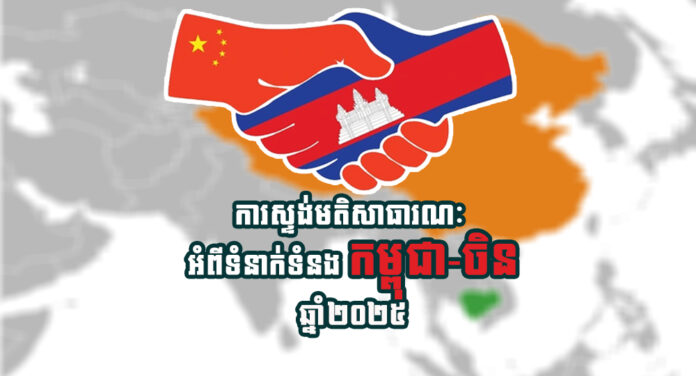
Phnom Penh: The Asia Vision Institute (AVI) recently completed its 2025 public survey on Cambodia-China cooperation and Cambodian people’s perceptions of Cambodia-China multidimensional cooperation in recent years.
The survey was conducted from December 2025 to March 2026 using an online questionnaire platform and face-to-face interviews. The survey was in the form of a questionnaire including multiple-choice, single-choice, and open-ended questions, with a response time of 10 to 15 minutes.
The purpose of the survey was twofold: The first part was to collect individual citizen opinions to obtain primary data and to directly understand citizens’ knowledge and understanding on the above topic. The second section presents a general perspective including opportunities, challenges and potentials, which are important inputs for proposing recommendations for strengthening Cambodia-China relations as the two countries have strengthened their steel ties and are implementing the action plan on building a Cambodia-China community with a shared future in the new era, including the Cambodia-China Diamond Hexagon Cooperation Framework and building on the existing strong cooperation dimensions.
In conclusion, the survey presented preliminary data that revealed the participants’ perceptions and views on the new trajectory of Cambodia-China relations in the context of recent cooperation, regional security developments and global geopolitical perspectives.
The Institute is pleased to provide the following survey results:
The survey received a total of 2,612 respondents from 25 provinces and cities across Cambodia. Respondents were aged 18 and above. The oldest participant was 73 years old and the average age was 37 years old. Approximately 796 or 30.47% of all respondents were based in Phnom Penh, with an average of about 4% of the respondents coming from 24 other capitals, cities and provinces in Cambodia. Respondents were civil servants, private sector workers, freelancers, workers, students, teachers, professors, farmers, media representatives, researchers or intellectuals from research institutes, tuk-tuk or taxi drivers, and members of civil society organizations such as NGOs. Compared to the 2024 survey (total of 2,635 respondents), the 2025 survey (total of 2,612 respondents) covered five additional provinces: Koh Kong, Mondulkiri, Oddar Meanchey, Pursat, and Ratanakkiri.
The survey provides a comprehensive understanding of participants’ views on the growing Cambodia-China relationship, the benefits of China’s development assistance and engagement in Cambodia in recent years, as well as the scope for further strengthening this relationship. The following are key points and a summary of the survey findings:
(1) Cambodia’s interest in China: Approximately 96.10% of respondents expressed a positive interest in China. A small percentage of respondents expressed negative feelings, which were found in the private sector, taxi drivers, and universities. When asked, “What attracts you to China?” the survey results showed that the average respondent chose three attractions. The three attractions were: attraction number 2 – Economic strength and business opportunities brought to Cambodia, attraction number 1 – Development methods and experiences that Cambodia can learn from,” and attraction number 3 – Achievements in science and technology, such as high-speed railways, e-commerce, etc.
(2) Views on Cambodia-China relations: A high number of respondents, approximately 97.4%, had an optimistic view of Cambodia-China relations, perceiving that the bilateral relationship is “full of hope and positive.” In contrast, only 2.6% of all respondents had a less optimistic view or perceived that the relationship was not very positive. Regarding the importance of this relationship, we observed that the dimensions of size and depth of this relationship were rated as very important. Approximately 99.7% of respondents felt that the Cambodia-China relationship was important for Cambodia, highlighting the strong foundation and important core key of the Cambodia-China “steel” friendship. Of these, 45.8% rated the relationship as important, while 32.4% considered the relationship to be the most important. On the other hand, approximately 21.6% of respondents felt that the relationship was as important as other countries. Of the 2,612 respondents, only 7 or 0.3% said that this relationship was not important.
(3) The Belt and Road Initiative (BRI) and its benefits: An assessment of which of the Cambodia-China Belt and Road Initiative (BRI) projects is the most interesting to Cambodia found that 49.27% of respondents indicated that the Phnom Penh-Sihanoukville Expressway Project has provided the most benefits, followed by the Sihanoukville Special Economic Zone Project (25.38%), the Siem Reap Angkor International Airport Project (11%), and the Cambodia-China Preah Kosom Friendship Hospital (10.34%). The survey data showed that the Belt and Road Initiative (BRI) has brought many benefits to Cambodia in many development sectors. The Belt and Road Initiative has not only brought development to Cambodia, but has also contributed to promoting the achievement of multidimensional development goals and benefits to Cambodia. According to the survey data, Cambodia has observed significant benefits from the Belt and Road Initiative in three key areas: 1) convenient infrastructure, 2) higher income, and 3) more job, education, and other development opportunities.
(4) Media: The survey showed that most Cambodians obtain information through three sources: 1) Cambodian media, 2) social media, and 3) workplaces/schools/communities/markets. This suggests that using only one type of media is not effective enough to reach Cambodians.
(5) Cultural, commercial, and political engagement: In 2025, several events were organized to promote understanding and communication between the two countries and their peoples. Among the six major events selected for the survey with Cambodians, three major events were frequently selected, including 1) Event 3: “China is Cambodia’s largest trading partner and source of investment. Cambodian agricultural products such as fresh durians have been approved for export to China,” 2) Event 1: “The Chinese President paid a state visit to Cambodia, and bilateral friendship was promoted to a China-Cambodia community that thrives in all seasons with a shared future in the new era,” and 3) Event 6: “China has played an important role in restoring peace and stability in the Cambodia-Thailand border area, including providing humanitarian aid of about 3 million US dollars to Cambodian refugees.”
(6) Strategic and Development Partners: Countries that have provided the most aid to Cambodia. According to the survey statistics, 77.11% of respondents identified China as the country that has the most support for Cambodia’s development. Specifically, when choosing a strategic partner between China and the United States, more than 42.19% of respondents chose China, while 16.08% chose the United States and 41.73% chose neutrality, not taking sides. The survey did not ask for the reasons for this choice. However, the results clearly show that in recent years, China has been involved and cooperated with Cambodia in more areas than the United States and other organizations.
(7) Challenges: The study showed that… a significant number of Cambodian citizens showed “little interest” and mentioned some challenges or negative impacts arising from bilateral cooperation between Cambodia and China or problems caused by some Chinese people living in Cambodia. Among all the comments, the concerns most frequently raised were related to online and offline fraud and other illegal activities. The survey also compiled a list of issues.
(8) Survey participants’ suggestions for future work: Some of the key suggestions that participants selected as priorities for the Chinese government to further strengthen and expand Cambodian-China cooperation include: 1- Provide more infrastructure assistance to Cambodia, 2- Import more agricultural products from Cambodia, and 3- Encourage Chinese companies to invest and create more jobs in Cambodia. Therefore, the sectors related to the above three points are considered the most important priorities for the development of Cambodia-China relations and cooperation in the future.
The Asia Vision Institute (AVI) is committed to promoting knowledge creation and co-creation, intellectual debate, knowledge exchange and development, as well as policy research and analysis, to make meaningful contributions to Cambodia’s development and add value to regional and global prosperity.
This site is translated by Google Translate™