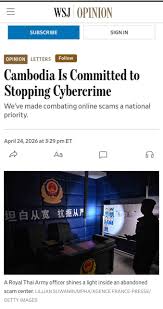
Phnom Penh: The use of the word “Scambodia” in an article by The Wall Street Journal (WSJ) is indeed a controversial topic that has provoked strong reactions from the Cambodian side. Cambodia considers the word “stigmatizing,” “demeaning,” and “disparaging” its national honor, which intentionally links the entire country to international criminal activities.
Cambodia has protested that this is a transnational crime problem that occurs throughout Southeast Asia (such as Myanmar and Laos), so targeting Cambodia is unfair and unprofessional.
The use of the word is a play on words by foreign media to attract attention (Sensationalism), but it has created a formal conflict between news organizations and the Cambodian government due to the impact on the country’s international image.
In geopolitics, politicians often use social or security issues to put pressure on a government. If the issue of “fraud” is exaggerated or focused solely on Cambodia (when it is a regional issue), it could be a sign of the issue being used as a political tool for political gain.
At this point, the question arises: “Are journalists being used in a smear campaign against a country?”
The authors of the article using the term are Gabriele Steinhauser and Patricia Kowsmann, but Philip Wen is a prominent reporter who has been reporting on the subject.
Indeed, Gabriele Steinhauser and Patricia Kowsmann are the authors of an investigative piece for The Wall Street Journal titled “How Cybercrime Became a Leading Industry in ‘Scambodia’”.
The article using the word “Scambodia” in The Wall Street Journal (WSJ) that caused a stir was the result of a joint investigation by a team of expert journalists.
The main writers known for their investigative work on the Southeast Asian tech crime issue for the WSJ are:
1. Philip Wen
He is a senior WSJ correspondent who focuses on politics and transnational crime in Asia. He has extensive experience tracking the influence of criminal groups and foreign investment involved in gray business.
2. The WSJ Investigation Team
Generally, such major articles are not written by a single person, but involve the participation of:
3. Field reporters: who go down to collect first-hand data in Southeast Asia.
4. Data analysts: who track financial flows and the digital currencies (Crypto) used by the scammers.
5. Gabriele Steinhauser and Patricia Kowsmann are investigative writers for The Wall Street Journal.
Use of the term in the headline: They were the ones who coined the term “Scambodia” in their headlines to describe the situation where criminal gangs were involved in corruption and forced labor in Cambodia.
For Philip Wen, it was a colleague who specialized in Cambodian affairs who helped them with information or wrote articles on the subject. Journalists like Gabriele and Patricia simply quoted the term in their headlines, but when it came to reporting on the issue regularly in the region, Philip Wen was the main player.
Here’s a brief history and why they used the term:
1. Gabriele Steinhauser
- Role: She is a senior reporter focusing on international economic and political issues.
- Experience: She has many years of experience reporting on conflicts, economic crises, and security issues in regions around the world.
2. Patricia Kowsmann - Role: She is an investigative reporter specializing in financial crimes, money laundering, and economic crimes.
- Experience: She regularly monitors and reports on how criminal groups use technology and banking systems to defraud victims around the world.
As for Gabriele Steinhauser and Patricia Kowsmann’s relationship with American politics, we can distinguish the following main points:
1. As Professional Journalists
Both are reporters for The Wall Street Journal (WSJ), the most influential American newspaper. As professional journalists, they must adhere to the principle of neutrality. This means that they are not politicians or work for any American political party.
2. Investigative connections
Although they are not politicians, their work has an impact and relevance to American foreign policy through: - Disclosure: In the article, they reported on companies sanctioned by the U.S. Treasury Department for suspected involvement in fraudulent transactions.
- Informing policymakers: When they write about “Scambodia” or transnational crime, these reports are often reviewed by members of Congress or U.S. government officials to determine policy or impose additional sanctions on individuals. or related institutions.
Of course, in connection with US policy, the United States, through the Treasury Department, often imposes sanctions on individuals or companies that they find involved in illegal activities.
- The United States considers online fraud to be a threat to the financial security of its citizens and the world.
- Political pressure: Investigative reporting by major media outlets is often seen as a tool to pressure local governments to enforce stricter laws.
Is it a “collusion” to tarnish Cambodia’s image?
From a professional journalistic perspective, institutions like The Wall Street Journal often claim their independence from the government. But in international politics:
- When journalists find evidence of crimes and the US government uses that evidence to punish them, it looks like they are doing the right thing.
In short, although this coverage hurts the feelings of the Cambodian people, in the eyes of the Americans, they understand that exposing the truth is the only way to promote reform and eliminate the criminal groups hiding under the banner of business in Cambodia.
In the past, Philip Wen Closely follows:
- Scam Networks: He reports on how criminal groups organize online scams.
- Sanctions and Security: He tracks U.S. statements and sanctions related to this issue on Cambodia. Although he is not named as the author of the article titled “scambodia,” Philip Wen is one of the most important reporters and actively reports on the “Scambodia” topic as the WSJ’s regional affairs expert.
Who is Philip Wen?
Philip Wen is an Australian. Although he looks Asian (Chinese-Australian), he was raised and educated entirely in Australia. Here are some facts about his identity:
•Nationality: Australian.
- Education: Graduated from the University of New South Wales (UNSW) in Sydney.
- Origin: He has Chinese heritage and has settled in Australia.
Philip Wen is a senior investigative journalist with extensive experience in the Asia region. Below is his background And his main career paths:
1. Education and early career
- He graduated in law and commerce from the University of New South Wales in Australia.
- He began his career as a journalist at The Sydney Morning Herald and The Age (Australia’s major newspapers), focusing on economic and business news.
2. Work experience in China - Before joining The Wall Street Journal (WSJ), he was a correspondent for Reuters in Beijing.
- During that time He has written many in-depth articles about Chinese politics, human rights abuses, and the influence of the Chinese Communist Party.
3. Work at The Wall Street Journal (WSJ)
- He is currently a senior correspondent for the WSJ based in Singapore.
- His main expertise is investigating transnational crime, corruption, and geopolitics in Southeast Asia.
- He is a key figure in tracking the “online fraud” story. (Cyber Scams) in Cambodia, Myanmar and Laos, which led to the use of the term “Scambodia” in the WSJ article.
4. Writing style
Philip Wen is known as a journalist who likes to write in the form of long-form investigation. He spends months collecting data, interviewing victims and tracing the flow of black money.
It has been concluded that Philip Wen is a highly professional journalist in the international eyes, but he is also a person who is “not very welcome” by the governments of some countries in Asia because his writings often dig up negative points and big scandals to expose.
Because the reporting of such journalists sometimes seems to be intentionally “inflating” small problems into big ones Which affects the image of the entire nation. If we look at Philip Wen’s writings and past work history, we can assess that his tendency towards the Cambodian government is in the nature of “aggressive criticism and investigation of weaknesses”.
We can divide his tendency into the following main points:
1. The tendency to see Cambodia as a “hostage to Chinese influence”
Philip Wen seems to believe that Cambodia has opened its hands to Chinese investors (both legal and illegal) to come in and exert too much influence. In his articles, he often links online fraud activities to the flow of capital from China and the lax enforcement of laws by the authorities that make it easy for these criminal groups.
2. Doubts about transparency and corruption
As an investigative journalist, he tends to show that the online fraud industry can flourish because of the “understanding” or “protection” of powerful individuals or corrupt officials. This is the point that makes the Cambodian government react the most, because it is an accusation without direct evidence, but uses speculative conclusions.
3. Strong focus on “human rights” and “human trafficking”
He tends to use Western human rights standards as a yardstick. In his writings, he often mentions the suffering of victims confined in special economic zones or casinos to pressure the Cambodian government to not pay attention to protecting foreigners who are victims of human trafficking.
4. “Adversarial Journalism” tendency
Philip Wen is not a journalist who writes praise or development news. His style is to find “loopholes”. When he sees a problem (such as wire fraud or money laundering), he will dig into it until it becomes an international topic, which greatly damages the government’s image.
In summary:
Philip Wen tends to be more “negative” than positive about the Cambodian government. He sees Cambodia through the lens of “regional security issues” and “The rise of crime” rather than the economic development efforts or the peace that the government is trying to maintain.
His use of the word “Scambodia” is the clearest evidence that he has little understanding or value for Cambodian national honor, as long as he can achieve his investigative reporting goals.
Has Philip Wen ever publicly apologized or made a correction to the word “Scambodia”?
There is no official evidence to date that he has publicly apologized or come forward to verbally correct the word.
However, in international journalism, when there is strong criticism from the public or the government, news organizations may sometimes edit the title or content of digital articles to reduce controversy, even if the journalist himself has not issued an apology statement. He did not come forward to “correct” it. The mistake is not the way the Cambodian public wants it, but the activity of using the word seems to have weakened due to pressure from criticism and the change of his working role to an institution that adheres to a higher code of ethics.
In particular, based on current information searches (as of May 2026), there is not much evidence or any public information that indicates that they actually have direct contact with American politicians.
Regarding the question of his relationship with American politicians, as journalists, they often have working relationships with government officials, diplomats, and politicians from various countries, including the United States. His relationship with American politicians, if any, is at the level of information sources and journalists only, and there is no data indicating political conflict.
Examination of the views surrounding the dissemination of the word “Scambodia” Some political observers and government officials have argued that the use of the term “Scambodia” in the WSJ investigative article appears to be a form of negative propaganda. The points raised include:
- Use of hyperbole: The change of Cambodia’s name to “Scambodia” (Scam + Cambodia) is seen as “smearing” and tarnishing the reputation of the entire nation due to the actions of a small group of criminals.
- Coherence with US reports: Critics have noted that these articles are often published at the same time as the US State Department issues negative reports on Cambodia (such as on human rights or human trafficking), raising suspicions of possible coordination behind the scenes.
- The influence of foreign agendas: In the context of geopolitics, reporting that focuses only on negative aspects has been interpreted as an information warfare tool to pressure the Cambodian government in line with the wishes of Western powers.
Of course, many social media observers understand that as professional journalists, they should not use such biased or stigmatizing language.
In general, as international journalists, the use of words that mangle (distort) the name of a country or use words in a strongly negative sense is often harshly criticized by the public and the government because it is seen as a lack of professionalism or an intention to discredit a nation, which harms the honor of the entire nation, not just the group of perpetrators.
In short, the story of The Wall Street Journal (WSJ) reporters and the term “Scambodia” has become a negative example of “freedom of the press” that lacks respect for the dignity of other countries.
In short, he continues to work as a journalist, but for the Cambodian public, his name is already marked on the “black list” of journalists who have previously disrespected Cambodia.
Author: Chim Ratha, an investigative journalist (freelance).
This site is translated by Google Translate™