
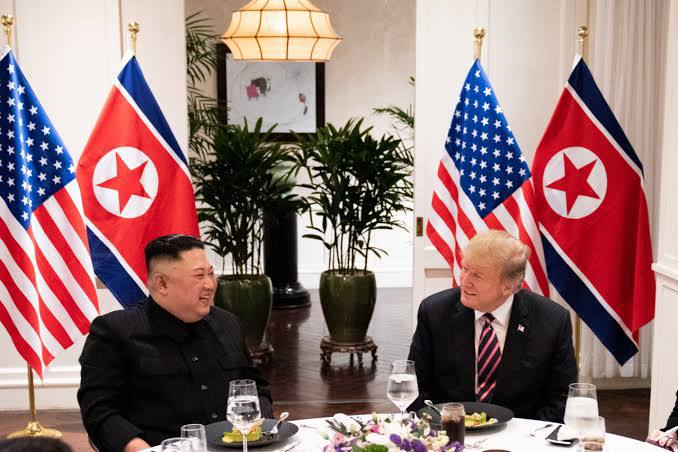
Nearly seven years after the 2019 Hanoi summit ended without any results, there are signs that direct talks between the leaders of North Korea and the United States are set to resume.
Since the start of his second term, President Trump has made numerous public remarks about Chairman Kim Jong-un—such as “He’s a smart guy and he likes me” and “I think we’ll meet again”—making no secret of his willingness to resume dialogue.
In particular, President Trump has recently hinted at ‘unconditional dialogue’—in which denuclearization is not set as a precondition—signaling an approach that differs somewhat from the past, and attention is now focused on whether North Korea will respond.
Amid these developments, U.S. State Department Spokesperson Tommy Pigott reaffirmed this open stance during a regular briefing on October 2, stating, “The President does not view dialogue with anyone as a concession. He is willing to meet with anyone if it serves the national interest.”
Meanwhile, while the issue of North Korea was discussed at the U.S.-China summit held at the White House last September, the fact that the shared goal of North Korea’s denuclearization was omitted from the official statement has led to interpretations that this was a strategic move to lay the groundwork for dialogue with North Korea.
Thus, the key variables in the diplomatic and security situation surrounding the Korean Peninsula in the second half of this year are narrowing down to whether the U.S.-North Korea summit will take place, as well as its timing and format.
The significance of the Talks : A starting point for easing hostilities and managing tensions in Northeast Asia
As of now, in 2026, If a North Korea-U.S. summit were to take place, it could go beyond being a mere diplomatic event and lead to fundamental strategic shifts regarding security on the Korean Peninsula, as well as the revival of a multilateral security framework in Northeast Asia.
In other words, even if these talks take place, it is highly likely that they will serve as a starting point for a ‘managed agreement’—one that halts North Korea’s nuclear and missile development, manages the risk of accidental conflict, and paves the way for phased negotiations—rather than a ‘big deal’ aimed at resolving North Korea’s nuclear issue in one fell swoop, as in the past.
Steve Biegun, former U.S. Special Representative for North Korea at the State Department, emphasized at a forum held in South Korea in late September that “while maintaining North Korea’s denuclearization as a long-term goal, it is realistic to slow or freeze the further expansion of its nuclear capabilities in the short term.”
If the high-level communication channels between North Korea and the United States—which have been severed since the 2019 Hanoi Summit—are restored, this could not only ease military tensions on the Korean Peninsula but also lay the groundwork for multilateral security cooperation involving China and Russia in the implementation and verification phases.
While the possibility has been raised that the agenda may include discussions on a declaration ending the war and the establishment of a peace regime on the Korean Peninsula, these issues are likely to be addressed as part of a phased denuclearization process rather than being finalized immediately, separate from denuclearization.
In other words, rather than the ‘declaration’ itself, what is actually frozen and what verification and corresponding measures are negotiated will serve as the yardstick for gauging the real success or failure of the summit and subsequent negotiations.
U.S. intentions : Domestic political objectives and securing a diplomatic legacy
Some analysts suggest that there are various strategic considerations behind President Trump’s push to resume talks with Chairman Kim Jong-un.
First, with Trump’s second-term foreign policy failing to yield tangible results in the Russia-Ukraine war and conflicts in the Middle East, there is an intention to revisit the North Korea-U.S. summit—which was deemed a ‘partial success’ during his first term—as a diplomatic breakthrough. In other words, given that his foreign policy achievements have been deemed lackluster midway through his term, it can be seen as a calculated move to turn the tide through a symbolic event.
Second, if the summit takes place, the intention is to once again highlight the historic symbolism of a U.S. president sitting face-to-face with North Korea’s supreme leader, thereby solidifying his image as a leader who manages security crises through negotiation and securing a political legacy that becomes increasingly important as his term progresses.
Third, the North Korea-U.S. summit itself is a symbolic means of maximizing the image of a ‘peacemaker’ on the international stage, and Trump will be able to establish a narrative in which he is a peace leader who has eased tensions on the Korean Peninsula through bold negotiations, rather than merely managing a crisis.
Fourth, some analysts suggest that this is a strategic move to remind South Korea and other allies of the transactional approach to alliance management and to secure an advantageous position in negotiations regarding defense cost-sharing, investment in the U.S., and security cooperation.
The need for US-North Korea Talks : Managing security risks and promoting stability in Northeast Asia
As of October 2026, the security environment in Northeast Asia remains unstable due to a combination of factors, including the ongoing nuclear and missile threats from North Korea, deepening military cooperation between North Korea and Russia, and intensifying strategic competition between the United States and China.
North Korea has, even recently, publicly rejected calls for denuclearization while emphasizing its status as a nuclear-armed state; coupled with its continued criticism of U.S.-South Korea joint military exercises and missile provocations, tensions on the Korean Peninsula remain high.
In particular, as the Russia-Ukraine war drags on, the deepening military cooperation between North Korea and Russia has become a key factor transforming the security environment on the Korean Peninsula into an even more complex and unpredictable situation.
Even between South and North Korea, North Korea has not responded to the tension-easing measures proactively implemented by the South Korean government, and a standoff continues in the border areas—where the possibility of accidental clashes cannot be ruled out due to activities such as border demarcation work.
Given that the persistence of such structural instability could lead to an increasing risk of armed conflict or military miscalculations, the resumption of dialogue between the leaders of North Korea and the United States could serve as a minimum safety net for managing tensions.
Furthermore, if the North Korean nuclear threat enters a phase of containment through the U.S.-North Korea summit, the military burden—such as the deployment of U.S. strategic assets and the strengthening of missile defense systems—will be reduced. This could help alleviate the pressure for a ‘domino effect’ of nuclear proliferation in Northeast Asia and slow the pace of the arms race.
In other words, the current situation on the Korean Peninsula is characterized by the interplay of three factors: ➀the escalating North Korean nuclear and missile threats; ➁changes in the security landscape resulting from closer ties between North Korea and Russia, as well as between North Korea and China; and ➂the breakdown in inter-Korean relations and tensions along the border. Consequently, the need for risk management through dialogue between the United States and North Korea is greater than ever.
Possibility of Talks : Prospects around the time of the november APEC Summit
The most likely timeframe for a U.S.-North Korea summit is said to be around the time of the APEC Summit, which will be held in Shenzhen, China, in November 2026. This is because a scenario in which the U.S.-North Korea summit takes place in conjunction with the multilateral diplomatic schedule— which includes a planned summit between President Trump and President Xi Jinping—would be the most natural course of events.
Three main locations are being discussed. First, there is a proposal to hold the meeting as a separate summit on the sidelines of the APEC multilateral diplomatic agenda in Shenzhen, China, which could ease the burden on both sides. Second, the option of holding the event in a third country, such as Singapore or Mongolia, could help create a balanced situation for both sides. Third, there is the possibility of President Trump visiting Pyongyang. While this would hold great symbolic significance as the first visit to Pyongyang by a sitting U.S. president, it is also considered an option that carries significant security, protocol, and political burdens.
While some observers believe that North Korea may prefer to host the event in Pyongyang, given its significant propaganda value for the regime, others argue that the United States would likely prefer a neutral third country or a multilateral diplomatic forum.
Through a summit with the United States, North Korea could send a message to the world that it is ‘engaging in dialogue as a country that already possesses nuclear weapons’ with the leader of the world’s most powerful nation, and it could also use this to strengthen regime cohesion and for internal propaganda. Furthermore, it could use this as leverage to reduce its excessive dependence on China and Russia and to enhance its strategic value among the major powers.
As Chairman Kim Jong-un is likely clearly aware that continuing to ignore the U.S. offer of dialogue—which could help him strengthen North Korea’s strategic position vis-à-vis the South and enhance its international standing through improved relations with President Trump—is not necessarily the most advantageous choic.
Under the current circumstances, if the United States were to propose talks merely for the sake of meeting without sufficient prior coordination, North Korea may have limited incentive to agree; consequently, it has become more important to determine what concrete concessions North Korea can secure from the United States through a summit.
While it remains unclear at this point whether the United States and North Korea will be able to find common ground for holding a summit, the APEC Summit to be held in Shenzhen, China, in November offers an opportunity to facilitate a meeting between the two nations. Therefore, now is the time for North Korea to demonstrate a proactive change in attitude in order to ease tensions on the Korean Peninsula and promote world peace.
Bd-pratidin English/Lutful Hoque
This site is translated by Google Translate™